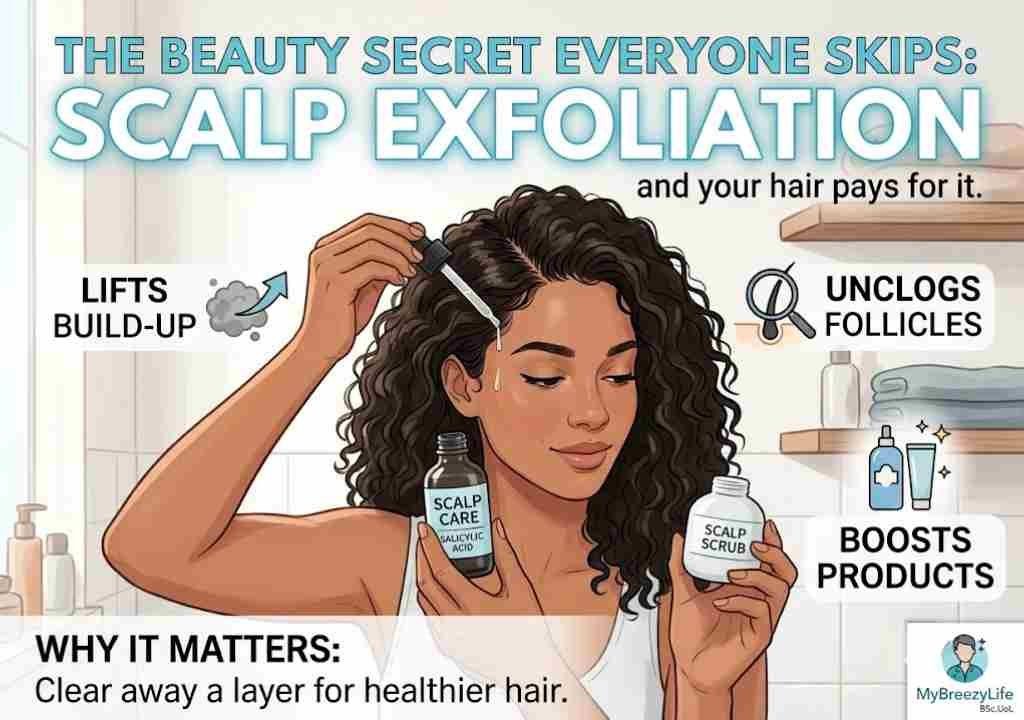
Scalp exfoliation is the step almost everyone skips, and your hair pays for it. We scrub our faces, we exfoliate our bodies, yet the skin under our hair gets ignored for months on end. As someone with a BSc in Cosmetic Science from the London College of Fashion at UAL, I find that strange, because the scalp is skin too, and it sheds dead cells, traps oil and collects product residue just like the rest of you. Clear that layer away and everything from your shampoo to your serum starts working better.
I have been testing scalp care methods for years, both on my own combination skin and for readers who write in to MyBreezyLife asking why their roots feel greasy two days after washing. The honest answer is usually build-up. Let me walk you through what scalp exfoliation actually does, how to do it safely at home, and the products and recipes worth your money in the UK.
What Scalp Exfoliation Is and Why It Matters
Scalp exfoliation is the process of removing dead skin cells, excess sebum and product build-up from the surface of the scalp. Think of it as the same idea as a face exfoliant, just applied to a different patch of skin that happens to have hair growing out of it.
Two things accumulate up there. The first is dead skin cells, which your scalp naturally sheds on roughly a 28-day cycle. The second is residue from the products you use, including dry shampoo, hairspray, leave-in conditioner and styling cream. Layer that with natural oil and you get a film that can leave hair limp at the root, dull along the lengths and slow to feel clean.
A congested scalp can also feel itchy or flaky. The NHS notes that flaking and itching are common and usually harmless, though persistent or severe symptoms are worth a GP visit, because conditions like seborrhoeic dermatitis and psoriasis need proper treatment rather than a home scrub. Exfoliation helps with everyday build-up. It is not a cure for a medical scalp condition, and that distinction matters.
The Science: Physical Versus Chemical Exfoliants
There are two routes, and they work in completely different ways.
Physical exfoliation uses small grains or a brush to manually lift debris away. Sugar scrubs, salt scrubs and silicone scalp brushes all fall into this group. The benefit is that you feel the massage and the results are immediate. The risk is that aggressive scrubbing on a sensitive or inflamed scalp can cause micro-tears, so a light hand is essential.
Chemical exfoliation uses acids to dissolve the bonds holding dead cells together, so they rinse away without scrubbing. Salicylic acid is the star here. It is a beta hydroxy acid, which means it is oil-soluble and can travel into a greasy hair follicle to break down sebum, which is exactly why you see it in anti-dandruff and clarifying formulas. Alpha hydroxy acids such as glycolic and lactic acid work on the surface instead, loosening dead cells and adding a little hydration.
Here is the counterintuitive part that surprises most people: a chemical exfoliant is often gentler than a gritty scrub. Acids do the work without friction, so for fine hair or a reactive scalp, a salicylic acid treatment usually beats a sugar scrub. I know, it sounds backwards, but the chemistry is straightforward.
How I Tested Scalp Exfoliation on My Own Routine
I committed to exfoliating my scalp once a week for eight weeks, alternating between a salicylic acid scalp serum and a DIY sugar scrub to compare them properly.
By week three the difference at my roots was obvious. My hair held a wash a full day longer before going greasy, and the slightly tight, itchy feeling I used to get along my hairline in Birmingham’s hard water had eased off. I noticed my volumising mousse actually gripped rather than sliding off a coated scalp. The acid treatment edged ahead of the scrub for comfort, though I genuinely enjoyed the scrub as a Sunday-evening ritual.
One thing I would flag from experience: more is not better. When I bumped exfoliation up to twice a week, my scalp got drier and flakier, not cleaner. Once a week was the sweet spot for me, and once a fortnight suits drier scalps.
How to Exfoliate Your Scalp at Home, Step by Step
Start on damp, freshly shampooed hair so the build-up is already softened. Part your hair into four sections so you can actually reach the skin rather than just coating your hair.
Apply your exfoliant directly to the scalp, not the lengths. For a scrub, use small circular motions with your fingertips or a soft silicone brush, working section by section for two to three minutes. For an acid treatment, apply along each parting and leave it on for the time stated on the bottle, usually five to ten minutes.
Rinse thoroughly with a gentle sulfate-free shampoo, then follow with conditioner on the mid-lengths and ends only. On the days you are not exfoliating, a weekly hair mask routine keeps your lengths nourished while the scalp work happens at the roots. Keep exfoliation to once a week at most. If your scalp ever stings, burns or stays red, rinse immediately and skip the acids next time.
DIY Scalp Exfoliation Recipes
You can make a perfectly good scalp scrub from things already in a UK kitchen, and yes, it does work. Always patch test on a small area first, and never use a DIY scrub on broken or inflamed skin.
Brown sugar and coconut oil scrub
Mix two tablespoons of brown sugar with one tablespoon of melted coconut oil. The sugar granules lift debris while the oil cushions the scrub so it does not drag. Massage into a damp scalp for two minutes, then shampoo out well. Best for normal to dry scalps.
Sea salt and aloe vera scrub
Combine one tablespoon of fine sea salt with two tablespoons of pure aloe vera gel. Salt is more abrasive than sugar, so this suits oilier scalps that can take a firmer exfoliation. Aloe calms any post-scrub redness. Rinse and shampoo as normal.
Oat and apple cider vinegar rinse
For sensitive scalps that cannot handle grit, blend two tablespoons of finely ground oats with a tablespoon of apple cider vinegar and enough water to make a paste. Oats are soothing and the mild acidity gives a gentle chemical lift without scrubbing. This is the one I reach for when my scalp feels reactive.
Best Scalp Exfoliation Products in the UK
If DIY is not your thing, these are scalp exfoliators I rate that are genuinely available on Amazon UK. Prices were correct at the time of writing in June 2026.
- The INKEY List Salicylic Acid Exfoliating Scalp Treatment, 150ml (around £9): a leave-on salicylic acid treatment you massage in before shampooing. My pick for an oily, build-up-prone scalp that wants chemical exfoliation without any scrubbing.
- The INKEY List 7% Glycolic Acid Exfoliating Scalp Scrub, 150ml (around £10.50): uses glycolic acid, an AHA, to loosen dead skin and product residue on the surface. Fragrance-free and gentle enough for weekly use.
- L’Oreal Paris Elvive Hydra Pure Exfoliating Pre-Shampoo Scalp Serum, 102ml (around £6.49): a high-street salicylic acid pre-wash serum and brilliant value. The one to try if you want to test acid exfoliation before committing to anything pricier.
- The Body Shop Tea Tree Hair & Scalp Scrub, 240ml (around £18): a physical salt-crystal scrub with tea tree, vegan and cruelty-free. Lovely for that deep-clean, tingly feeling on an oily scalp.
- Umberto Giannini Exfoliating Anti-Dandruff Scalp Rescue Scrub (around £8.95): vegan and cruelty-free, aimed at flaky, build-up-prone scalps. A well-reviewed, good-value physical scrub if you prefer a wash-in option.
Halal status: The Body Shop and Umberto Giannini are certified cruelty-free and vegan, and The INKEY List is cruelty-free with many vegan formulas. None of these are halal certified as standard. As always, verify current certification and the full ingredient list directly with the brand, since formulations change.
Scalp Exfoliation for Hijab-Wearing Women
For hijab-wearing readers, scalp exfoliation deserves a particular mention, and it sits naturally alongside the rest of your routine, including our skincare routine for hijabi women. Hair kept covered for long stretches sits in a warmer, less ventilated environment, which can encourage sweat and sebum to build up faster at the roots. That is not a hygiene failing, it is simply physics.
A weekly exfoliation, paired with making sure hair is fully dry before covering, helps keep the scalp comfortable and reduces that heavy, coated feeling by the end of a long day. A lightweight salicylic acid treatment tends to suit this best, because it clears oil without leaving residue of its own. If you wear your hair in a tight bun under the scarf, take extra care along the hairline where tension and build-up both gather.
Frequently Asked Questions
How often should you exfoliate your scalp?
For most people, once a week is ideal. Oily scalps can sometimes manage twice a week, while dry or sensitive scalps do better once a fortnight. Over-exfoliating strips natural oils and can leave the scalp drier and flakier.
Does scalp exfoliation help hair growth?
It does not directly grow hair, but a clean, healthy scalp is a better environment for the hair you have. Removing build-up around the follicles can support thicker-looking, healthier growth, though there is no scrub that reverses genuine hair loss. If growth is your main goal, pair exfoliation with a nourishing routine such as our homemade Ayurvedic hair growth oil applied to a clean scalp.
Can scalp exfoliation get rid of dandruff?
It can help with the everyday flaking caused by build-up and dry skin. True dandruff linked to seborrhoeic dermatitis usually needs a medicated anti-dandruff shampoo with an active such as ketoconazole or zinc pyrithione. See your GP or pharmacist if flaking is persistent.
Is a scalp scrub or a salicylic acid treatment better?
For fine hair or a reactive scalp, a salicylic acid treatment is usually gentler and more effective because it dissolves build-up without friction. A physical scrub feels satisfying and works well for normal scalps that are not inflamed.
Can I exfoliate my scalp if I have coloured hair?
Yes, but time it carefully. Exfoliate a day or two before colouring rather than straight after, as fresh acids and scrubs can speed up colour fade. Stick to once a week and condition well afterwards.
The Takeaway
Add scalp exfoliation to your routine just once a week and you will likely notice cleaner roots, less itch and hair that behaves better between washes. It slots neatly alongside the rest of your seasonal hair care routine. Start gentle, listen to your scalp, and treat any persistent flaking or soreness as a reason to see a professional rather than scrub harder.
Beauty and Wellness content at MyBreezyLife is created by our editorial team and reviewed by founder Noreen Fahad. Clinical claims are referenced. This article contains affiliate links. We only recommend products we genuinely rate. This is general guidance only. Always consult your GP or a qualified professional for personal advice.