
Learning how to start mindfulness meditation is one of those things that sounds deceptively straightforward until you actually sit down, close your eyes, and realise your brain has immediately decided to compose a shopping list. I have been there. Most of my personal training clients have been there too, which is exactly why I want to walk you through this properly rather than hand you a vague list of breathing tips and wish you luck.
Mindfulness meditation is not about emptying your mind. That is probably the most common misconception I come across, and it stops a lot of women from even trying. The actual goal is to bring your attention to the present moment, notice when it wanders, and gently bring it back. That is the entire practice. Simple to explain, genuinely useful to develop, and very much something a complete beginner can start today.
Why Mindfulness Meditation Matters for UK Women
Stress is not just a feeling. As someone with a BSc in Sport and Exercise Science from Brunel University, I spent a good part of my degree studying how the body physically responds to pressure. Cortisol, your primary stress hormone, stays elevated during sustained periods of mental strain and disrupts everything from sleep quality to immune function to mood regulation.
Mindfulness meditation directly counters this by activating the parasympathetic nervous system, the part of your nervous system that signals the body to rest and recover. According to the NHS, regular mindfulness practice has been shown to reduce stress and anxiety, improve sleep, and support overall mental wellbeing. For UK women juggling work, caregiving, and a mental load that never quite switches off, even ten minutes a day creates a measurable shift over time.
Bear with me on this one, because the evidence is more compelling than the word “meditation” sometimes suggests.
How to Start Mindfulness Meditation: 5 Practical Steps
Step 1: Let Go of the Idea of a Perfect Session
This is the step no one leads with, but it is the most important one. Mindfulness meditation will feel uncomfortable at first. Your thoughts will race, you will feel fidgety, and you will almost certainly spend your first few sessions thinking about whether you are doing it correctly. That is not failure. That is exactly what the early practice feels like for everyone.
I started meditating properly in the winter of 2021 during a particularly overwhelming period of my editorial work, and my first two weeks were deeply unimpressive. I sat for ten minutes, thought about everything except my breath, and convinced myself I was doing it wrong. What I was actually doing was building the habit. Progress in mindfulness is not measured by how still your mind is. Progress is measured by how quickly you notice when it has wandered and how kindly you bring it back.
Give yourself permission to have imperfect sessions. Every single one still counts.

Step 2: Start With Breathing Exercises Before Anything Else
Before you attempt a full seated meditation, spend a week just practising conscious breathing. This trains your nervous system to respond to breath as a cue for calm, which makes meditation significantly easier when you add it.
The method I recommend to every client who is new to this is box breathing: inhale for four counts, hold for four, exhale for four, hold for four. Repeat six times. It takes under three minutes, and you can do it anywhere. At your desk, in a parked car, lying in bed before your alarm goes off. The mechanism is physiological rather than mystical. Slow, deliberate exhales stimulate the vagus nerve, which directly reduces the stress response in your brain. And yes, it works even if you feel slightly self-conscious the first few times.
Once this feels natural, you are ready to build it into a sitting meditation practice.
Step 3: Set Up a Space That Supports the Habit
You do not need a dedicated meditation room. You do not need cushions, candles, or any equipment at all. What you do need is a consistent spot that your brain begins to associate with stillness. A corner of your bedroom, a specific chair, a particular spot on the floor. Consistency of place helps consistency of practice.
Keep your phone in another room, or at minimum on silent and face down. The research on this is fairly clear: the mere presence of a smartphone on a desk reduces available cognitive capacity, even when it is not being used. Your meditation space should have as few competing stimuli as possible.
Timing matters too. Morning meditation, before the day builds momentum, tends to be easiest to maintain as a long-term habit. Even five to ten minutes after Fajr, or before you check your phone in the morning, is enough to establish the practice. I personally find Sunday evenings useful as a second session to mentally prepare for the week ahead.
Step 4: Follow a Simple Beginner Meditation Structure
For your first four weeks, keep it simple. Complexity can come later. Here is a ten-minute structure that works:
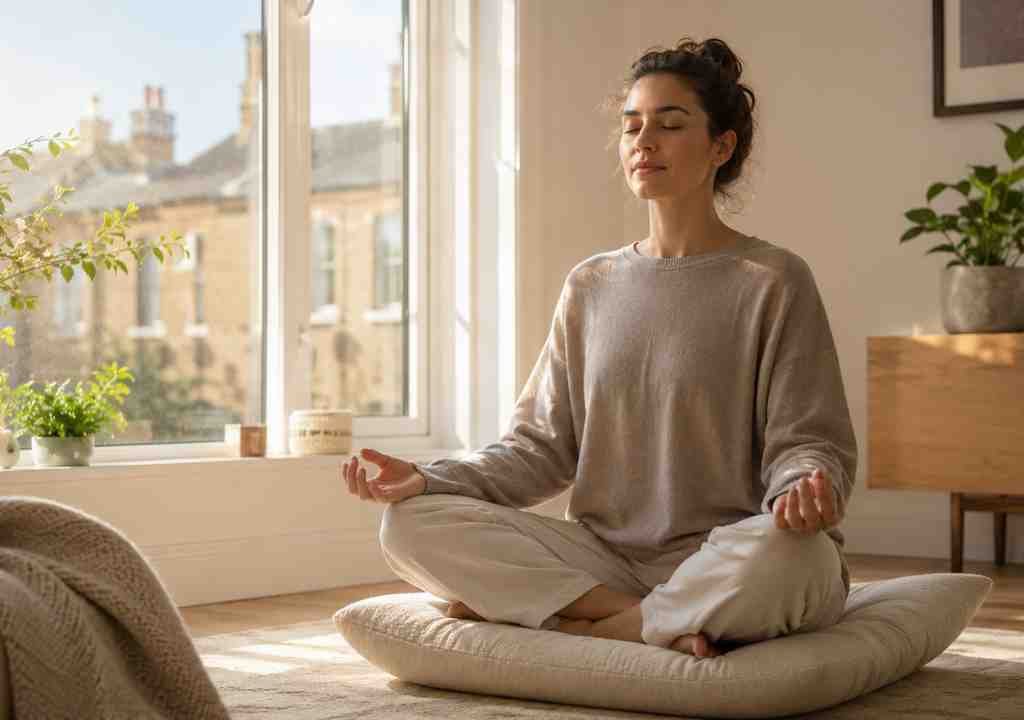
Minutes 1 to 2: Settle into your position, either seated cross-legged on the floor or upright in a chair with your feet flat. Let your hands rest in your lap. Close your eyes or soften your gaze downward. Take three slow, deliberate breaths to signal to your body that you are shifting gears.
Minutes 3 to 8: Bring your attention to the physical sensation of breathing. Not the idea of breathing, but the actual feeling: the rise of your chest or belly, the slight coolness of the air as it enters your nose, the warmth as it leaves. Each time a thought appears (and it will), simply notice it without judgment and return to the breath. Notice, return. Notice, return. That is the practice.
Minutes 9 to 10: Gradually widen your awareness. Notice sounds around you, the feeling of the floor or chair beneath you, the temperature of the room. Take two final deep breaths and gently open your eyes.
That is a complete beginner meditation session. Nothing more is needed to start.
Step 5: Build Gradually and Track What You Notice
Starting at ten minutes is enough. After two weeks, move to fifteen. After a month, you will likely find that twenty minutes feels short. The benefits of mindfulness meditation are cumulative rather than immediate, which means consistency over weeks matters far more than the length of any single session.
Keep a brief note, even just one sentence, after each session. Not an analysis, just an observation. “Felt distracted but calmer afterwards.” “Mind was very busy, but I stayed for the full ten minutes.” Over several weeks, you will start to notice patterns in when your mind is most settled and when it is most restless, and that self-knowledge is genuinely useful beyond the meditation practice itself. For more on building a sustainable self-care routine around mindfulness, see our guide to [self-care routines for UK women][INTERNAL LINK NEEDED — topic: sleep and self-care routines].
Modifications for Every Starting Point
Complete beginner version: Start with three to five minutes of box breathing only. Do not attempt seated meditation yet. Spend the first week simply practising intentional breath. Add a minute of silent sitting at the end once the breathing feels comfortable.
More experienced version: Extend the core meditation to twenty minutes and experiment with a body scan: after the initial breathing focus, slowly move your attention through different areas of the body from the feet upward, noticing sensation without trying to change anything. This is particularly useful for women who carry physical tension from stress. You might also find it useful to combine seated meditation with a movement practice. Our article on yoga meditation as a way to get control over your mind covers how yoga and meditation work together as a complementary pair.
Ramadan-safe version: Meditation after Iftar, once you have eaten and prayed, is a natural fit. Allow at least thirty minutes after eating before sitting. The stillness of Tarawih prayer shares much of the same physiological benefit as seated meditation, so on nights when you attend, the formal meditation practice can be shortened or skipped without losing the benefit. Hydration during Ramadan affects concentration, so aim to drink at least two glasses of water before your evening session. Always consult your GP if you experience dizziness or weakness while fasting.
Mindfulness Meditation for Muslim Women
For Muslim women, it is worth naming something that mainstream wellness content often sidesteps entirely. The mindfulness that underpins formal meditation practice and the mindfulness present in Islamic worship are not as separate as they might appear. The focused attention required in Salah, the present-moment awareness of dhikr, and the intentional stillness of sitting in reflection after prayer all work through similar mechanisms on the nervous system.
Secular mindfulness meditation is not in conflict with Islamic practice. Many Muslim women I know use formal meditation as a complement to their existing practice of prayer, particularly during demanding periods when mental stillness is harder to access. If the secular framing does not feel right, simply use the time for focused recitation of dhikr or quiet reflection after prayer. The physiological benefit is the same.
For hijab-wearing women or those who prefer to exercise and practise at home, seated meditation requires no equipment and no particular clothing, making it one of the most genuinely accessible wellness practices available. A quiet corner at home is all you need. For wider mental wellbeing support tailored to Muslim women in the UK, Muslim Women’s Network UK has excellent resources.
Helpful UK Tools and Resources
You do not need to spend anything to start a mindfulness practice. The NHS Every Mind Matters programme at nhs.uk/every-mind-matters offers free guided mindfulness exercises that require no prior experience. The Headspace app has a free basic plan that is a solid starting point for structured beginner sessions. Calm offers a similar free tier.
If you prefer a physical prompt to anchor the habit, a simple timer and a comfortable cushion are the only tools worth buying. A meditation cushion (called a zafu) is available from Amazon UK for around £18 to £25, and it makes a genuine difference to posture during longer sessions. For more on building a consistent morning routine around these habits, see our guide to [morning routines for UK women][INTERNAL LINK NEEDED — topic: morning routine for women].
For mental health support beyond stress management, Mind UK offers clear guidance on anxiety and low mood, and Samaritans are available 24 hours a day on 116 123. Please do reach out to your GP if stress or anxiety feels persistent or overwhelming.
Frequently Asked Questions
How long should a beginner meditate for?
Start with ten minutes. That is genuinely enough to establish the habit and notice a benefit. Extend to fifteen or twenty minutes after two to three weeks. Duration matters less than consistency, so ten minutes every day produces better results than thirty minutes twice a week.
Is mindfulness meditation the same as clearing your mind?
No, and this misconception stops many beginners before they start. Mindfulness meditation is about noticing thoughts and gently returning your attention to the breath, not about stopping thoughts altogether. A busy mind during meditation is normal, not a sign of failure.
Can I meditate lying down?
You can, but most mindfulness teachers advise against it for beginners because the body associates lying down with sleep and you are likely to drift off. A seated position with a straight spine, either on the floor or in a chair, keeps you alert enough to maintain focused attention.
How quickly will I notice results from mindfulness meditation?
Most people notice a subtle shift in how they respond to stress within two to three weeks of daily practice. Deeper benefits, including improved sleep quality and reduced baseline anxiety, tend to appear after four to six weeks of consistency. Research consistently shows that eight weeks of regular practice produces measurable changes in how the brain processes stress.
Is mindfulness meditation suitable during Ramadan?
Yes. Seated mindfulness meditation is low-intensity and requires no physical exertion, making it suitable at any point during the fasting day. Many women find a short session after Fajr prayer or before Iftar particularly grounding. As always, consult your GP if you experience any physical symptoms during fasting.
Mindfulness meditation is one of the few genuine wellbeing practices that costs nothing, requires no equipment, and gets meaningfully easier the more you practise it. Start with ten minutes today. Put nothing else on the list for now.
Yasmin Demir is MyBreezyLife’s Health and Fitness Editor, holding a BSc in Sport and Exercise Science from Brunel University and a REPs Level 3 personal trainer certification. All recommendations are based on personal experience and independent research.
Health and Fitness content at MyBreezyLife is created by our editorial team and reviewed by founder Noreen Fahad. This is general guidance only. Always consult a qualified professional for personal health advice. For mental health support, contact Mind UK at mind.org.uk or Samaritans on 116 123.